
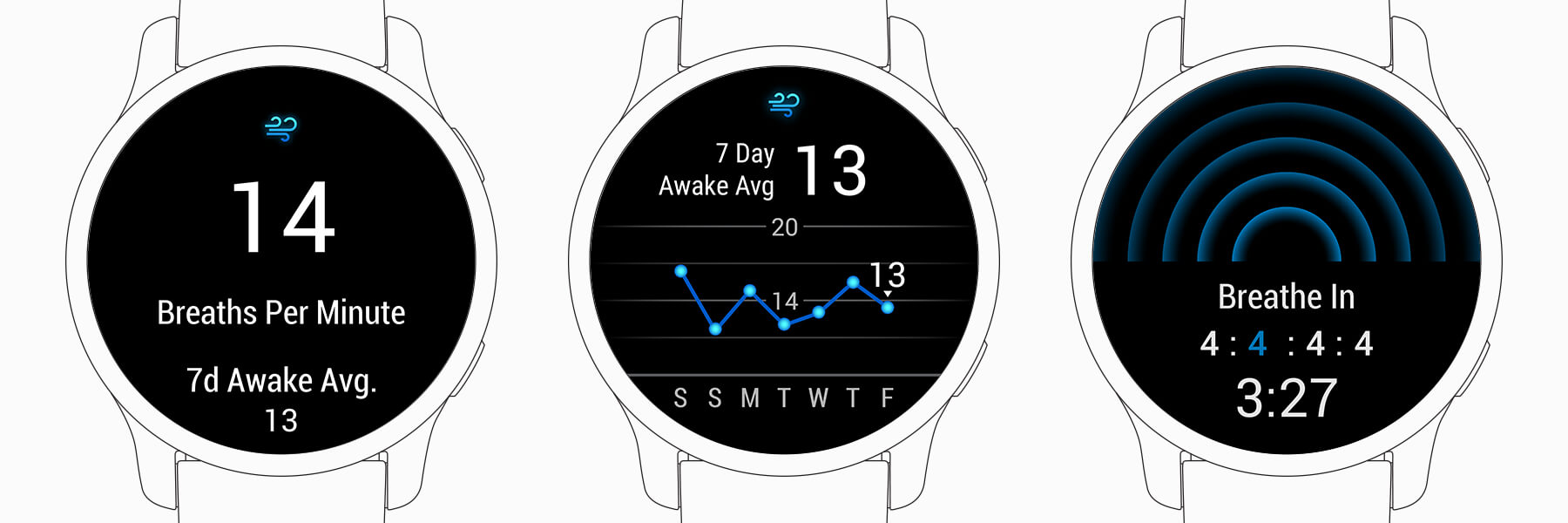
You can consciously control your breathing to a certain extent, but most of the time we breathe in and out day and night without thinking about it. That's because your respiration rate — like your heart rate — is regulated by your autonomic nervous system (ANS). And since the commands come from the same source, the breathing command is encoded in the messages your autonomic nervous system sends to your heart1.
The interval between heartbeats is slightly shorter when you inhale and longer when you exhale. This remarkable phenomenon is known as sinus arrhythmia. Arrhythmia may sound alarming, but this is a completely normal and healthy phenomenon2.
In general, a slower breathing rate at rest is a sign of good physical fitness. Fitter people breathe more slowly even when they are active, and their respiration rate recovers faster after physical activity.
The normal resting respiration rate for an adult is 12 to 20 breaths per minute. It varies from person to person, and during periods of activity your respiration rate may be higher.
If your resting respiration rate rises significantly above or falls below average, it may indicate a significant change in your health or poor air quality. Keep in mind that your Garmin device is not intended for medical purposes. For any questions about your breathing metrics, you should consult your family doctor or another qualified healthcare professional.
Breathwork
Whether you want to increase mindfulness, reduce stress, improve mental sharpness and performance, or prepare for sleep, breathing exercises or mindful breathing can help.
On compatible Garmin devices, you can use the built-in breathwork activity profile to practise three different breathing techniques: Tranquility, Coherence, and Relax and Focus. Here is what practising these techniques can do for you.
Tranquility
This 10-minute exercise helps you prepare for sleep. Practise slowly until you can inhale for 4 seconds, hold your breath for 7 seconds and exhale for 8 seconds.
Coherence
As a result of this 15-minute exercise, you should feel balanced and calm rather than excited or extremely relaxed. Gradually slow your breathing until you reach a steady 6-second inhale and 6-second exhale.
Relax and Focus
This 15-minute exercise helps you reach a focused, stress-free state. Sometimes called box breathing or four-square breathing, this technique helps you achieve a 4:4:4:4 breathing pattern - inhale for 4 seconds, hold for 4 seconds, exhale for 4 seconds and hold again for 4 seconds.
There is also a 5-minute version of this exercise, which is recommended when the watch detects an unusually large rise in stress and shows a „relax reminder” alert.
When you finish, the watch displays the duration of the exercise, your average heart rate during the exercise and the detected change in stress level as a result of the breathwork. You can also view each exercise in the Garmin Connect™ app to see charts of respiration rate, stress and heart rate for the session.
Don't give up, even though breathing exercises may feel strange at first. As you get used to the breathing patterns and learn to control your breathing better, you'll notice more and more benefits. Like any other training, it takes practice. But unlike many workouts, you don't need equipment or lessons. All you need is a quiet space … and maybe a cushion.

1F. Yasuma and J. -I. Hayano, “Respiratory sinus arrhythmia: why does the heartbeat synchronize with respiratory rhythm?,” Chest, vol. 125, no. 2, pp. 683-90, 2004.
2G. E. Billman, “Heart Rate Variability — A Historical Perspective,” Frontiers in Physiology, vol. 2, no. 86, 2011.