

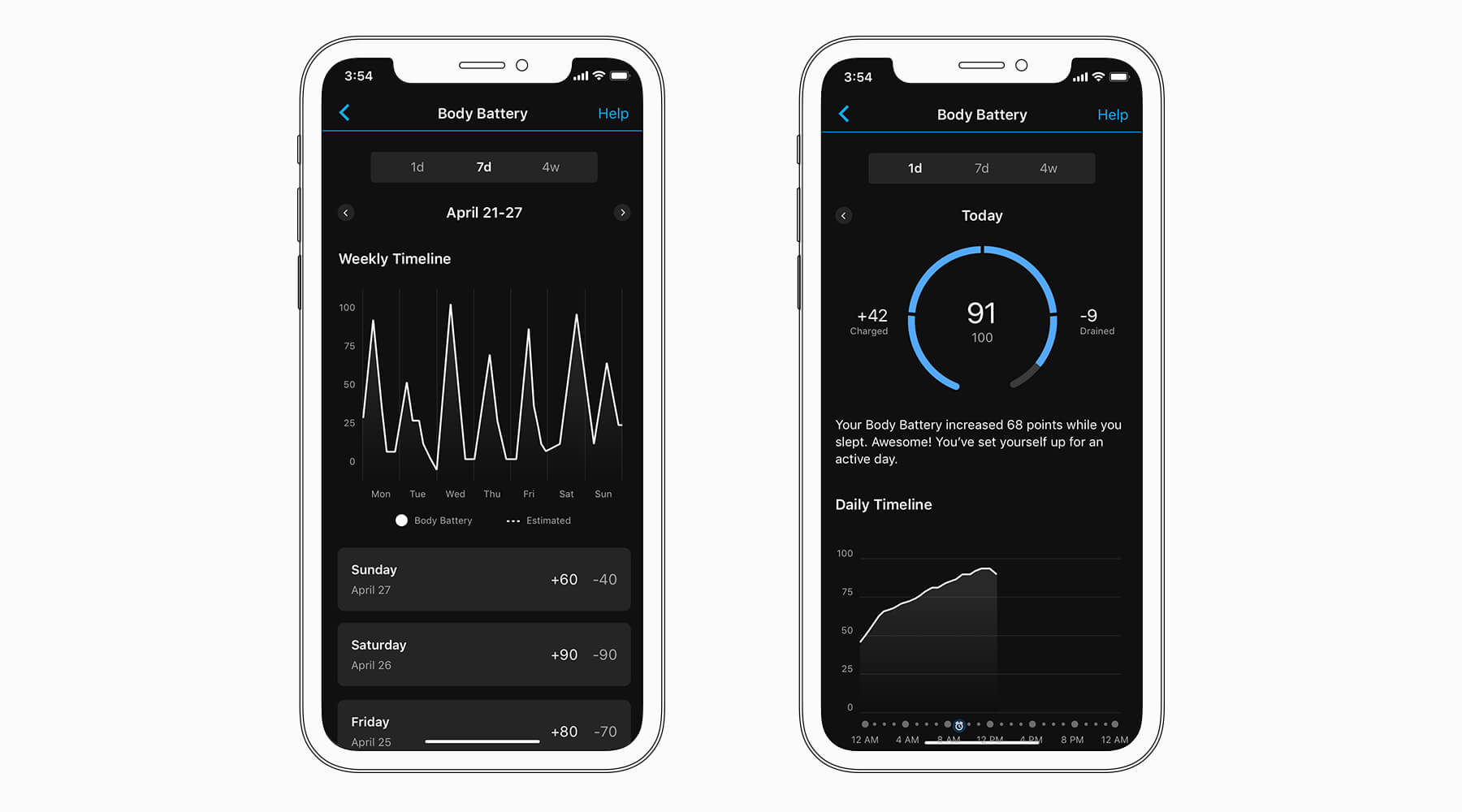
The Body Battery feature on your Garmin watch helps you manage your personal energy reserves. That way, you always know when you're ready to benefit from exertion and when it would be wiser to take it easy. By showing the restorative effects of physical activity, stress, relaxation and sleep together in one place, Body Battery also helps you understand how your activities and lifestyle choices affect your condition. So you can see what works best for you.
Physical activity, stress and sleep all affect your ability to keep up the pace, take on challenges and adapt to your environment. Our Body Battery feature, powered by the Firstbeat analytics engine, takes all of these elements into account to give you a simple, easy-to-read overview of your body's energy levels.
Success is built on managing your resources wisely. That's why we created Body Battery. Using your own physiological feedback, this cutting-edge technology helps you manage your energy efficiently in everyday activities with personalised insights.
Charging your body battery
Your body needs rest. The energy you need to perform at your best mentally and physically is gathered during periods of rest, when stress levels are low.
Quiet moments of rest and short naps during the day help raise energy levels, but good sleep quality has the greatest impact. It's an undeniable fact that sleep is our body's most valuable recovery time.
From a recovery standpoint, good sleep quality is characterised by heart rate variability (HRV), meaning slight irregularity between successive heartbeats1. This is a normal, healthy sign that your parasympathetic nervous system is active and dominant over the sympathetic nervous system.
Tracking your feedback over time shows what works best for you.
Activity and stress drain your battery
The demands you place on your body during the day deplete its resources. This is reflected in a drop in your Body Battery level. Physical activity is a significant load, but stress levels also play their part.
What do we mean by stress? Stress is a state of arousal and our body's natural, healthy response to the various challenges that life and our environment present. It is a heightened physiological state resulting from the activation of our sympathetic nervous system – the so-called fight-or-flight response – and it can also be detected by analysing heart rate.
Stress has a bad reputation because unpleasant experiences are often stressful. Getting stuck in traffic, looming deadlines and managing demanding professional relationships are all negative emotional experiences that often trigger the body's stress response. But happier times can also trigger stress responses. Enthusiasm, excitement and anticipation are also emotional states that correspond to elevated stress levels in the body.
Even so, joyful anticipation before a holiday is certainly more fun than nervously shuffling through airport security, but from a physiological point of view both have a draining effect that must in turn be offset by sufficient recovery.
How fitness affects your body battery
If you take some time to understand how your fitness level affects your body battery, you'll be well prepared for what lies ahead. To do this well, you need to appreciate the difference between physical activity (i.e. training) and fitness. These closely related concepts affect your body battery in somewhat opposite ways, depending on whether you look at daily results or the bigger picture.
A good measure of your fitness level is VO2 max, which shows how well your heart, lungs, circulation and muscles work together to produce aerobic energy. The best way to improve your fitness level is regular training at a vigorous intensity.
Training drains your body battery according to the intensity of the effort. Higher-intensity activities drain your body battery faster than low-intensity activities. But the better your fitness level becomes, the smaller the relative impact of training and stressful experiences on your body, and the faster you recover.
In other words, better fitness means a better ability to cope with stress and train more without completely exhausting yourself. This reality is built into the Body Battery feedback provided by your Garmin device. It means that although daily training depletes your body's resources, the net benefit is positive in the long run.
Body battery and mental health
Because your brain is part of your body, your ability to think, focus, solve problems, regulate emotions and cope is strongly linked to and influenced by your physiological state.
When you're well rested and your body battery is charged, you'll probably notice that you're at or near the peak of your mental abilities. You feel physically fresh and mentally alert, as if it's time for action.
You may also be interested to know that psychologists increasingly recognise that self-control and delayed gratification are also depletable resources. Both are strong predictors of success in many areas of life. Wouldn't you agree that you're more likely to make mistakes and unhealthy choices when your energy levels are low?
But this doesn't only affect doing chores, tackling projects at work or sticking to a diet. Sports psychologists and statisticians who regularly work with professional athletes confirm that our ability to think quickly and make smart moves declines the more tired we get during a game or a long match.
Should a low body battery level be a concern?
Life is full of ups, downs and surprises. We usually can't choose when challenges arise. There will always be times when work needs doing even though energy levels are low. Sometimes you just have to grit your teeth and get things done, but constantly living on an empty battery can cause various health problems. It also inevitably means you won't reach your full potential.
With this in mind, occasional low-energy days are no reason to worry, especially if you understand why you're in that situation. Are you coming down with something? Did you not get enough rest last night? Are you pushing yourself for a deadline? These situations pass and soon you'll feel like yourself again. But if you feel your body battery is constantly near empty, it may be time to look at what you could do better.
Knowledge is power, and it's worth knowing that a low energy level doesn't mean you can't train. Training may be hard, but somehow you'll push through in the end. But just because you can doesn't mean you should. The downside of training hard on a depleted battery is that in the long run your efforts may actually hold you back.
The return or benefit of training comes in the form of the physiological adaptations your body makes in response to exertion. Remember that when you're tired, haven't slept or your stress load has been too high, your body can't get the maximum benefit from training.
1E. Vanoli, P. B. Adamson, Ba-Lin, G. D. Pinna, R. Lazzara and W. Orr, “Heart Rate Variability During Specific Sleep Stages”, American Heart Association: Circulation, vol. 91, no. 7, pp. 1918–1922, 1995.