
Knowing that radio waves travel in a straight line, we need to take the curvature of the Earth into account when calculating the maximum range of a two-way radio. When you stand on the ground and press the talk button on a VHF device, the radio waves travel straight ahead, and once they pass the horizon they simply continue straight out into space. So the distance to the horizon is technically the maximum communication range of a two-way VHF device. However, we also need to take the antenna height into account.
To find the line-of-sight distance to the horizon based on antenna height, we can use the following formula: horizon in kilometres = 3.569 times the square root of the antenna height in metres.
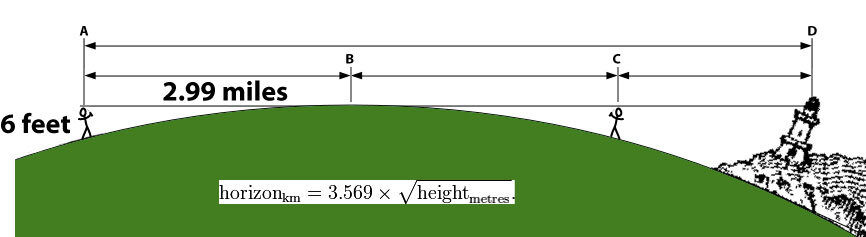
So if the radio antenna is 6 feet or 1.82880 metres high, the distance to the horizon is approximately 4.83 kilometres or 2.99 miles, which is point B in the diagram. Of course, this calculation assumes that the receiving antenna is right at ground level, so raising it higher would extend the line of sight.
Point C in the diagram shows another radio device with its antenna at a height of 6 feet (1.83m), so theoretically you should be able to communicate almost 6 miles (9.6km). So in reality, the maximum communication range between two people carrying handheld radios on flat, unobstructed terrain is about 4–6 miles. (6.4km - 9.6km)
You may then wonder why the specifications of many devices state up to 9 miles (14.4km) or more. Technically, the devices are capable of communicating that far.
Point D in Figure 1 shows a tower located on top of a hill. If you stand on top of this tower, your antenna height now clears a much larger portion of the Earth's curvature and you can communicate much further.
VHF radio range is also affected by other factors, such as the weather, the frequency used and obstacles (mountains, hills, trees, buildings, phone masts, power lines, etc.).