
Rait Ratasepp: THE BODY LIKE CLOCKWORK

18.04.2023
 Reading time: 5 minutes
A sports watch is one of many tools I use to keep getting better at understanding and listening to my body. By analysing what I do, I discover again and again how precisely our body works and communicates with us. Our job is to notice it, draw the right conclusions and turn them into results.
On average, a person consumes 1 million kcal a year, and without counting calories and by listening to the body properly, our weight stays remarkably similar from year to year. Take my own sport as an example. Achieving and then maintaining a balance between energy consumed and energy burned is crucial in ultra sports. During the 60x ultra triathlon, according to my Garmin watch, I burned 506 510 kcal over 60 days. Although there was no way for me to calculate my energy intake down to the calorie by logging my food, body weight gives good feedback on the balance between energy burned and consumed. On the mornings of the first and last day of the 60x ultra triathlon, I weighed exactly the same to within a hundred grams (76.8 kg), even though for those entire two months I ate based solely on how I felt.
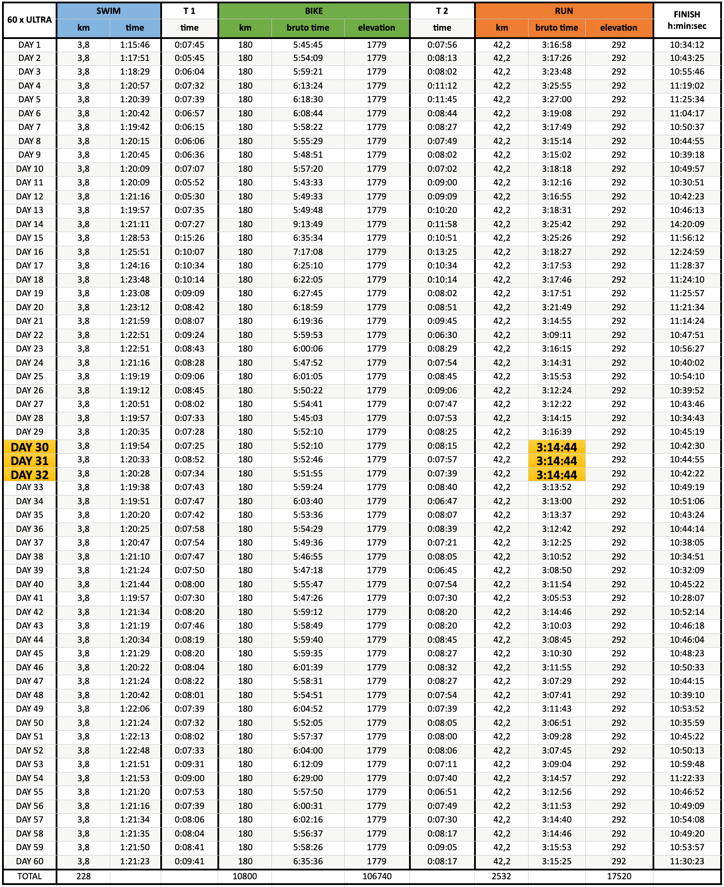
Body weight and calories are just one example of many, though. The 60x ultra triathlon also illustrates the body's incredibly precise working capacity. On three consecutive days (days 30 to 32), having first swum 3.8 km and cycled 180 km each day, I ran 42.2 km in exactly the same time to the second (3:14:44). And this was not deliberate pacing, and timing was electronic. During the run, I only looked at my watch at 21.1 km to tell a team member my half marathon time for a social media post.
I also noticed many consecutive bike and run laps completed with to-the-second precision when analysing the timing file from last August's 5x ultra triathlon in Switzerland. For example, while running the marathon on the third day, I completed as many as four consecutive 1.21 km laps in exactly the same time to the second (5:48 min:sec/km).

Today, thanks to my watch, I have learned to assess my running pace and current form very accurately, and, for example, when giving a maximum effort in races, I don't adjust my pace based on the watch or heart rate. Everything is done by feel, and afterwards I review and analyse the metrics recorded by the watch.
Photo: Jakob Meier