

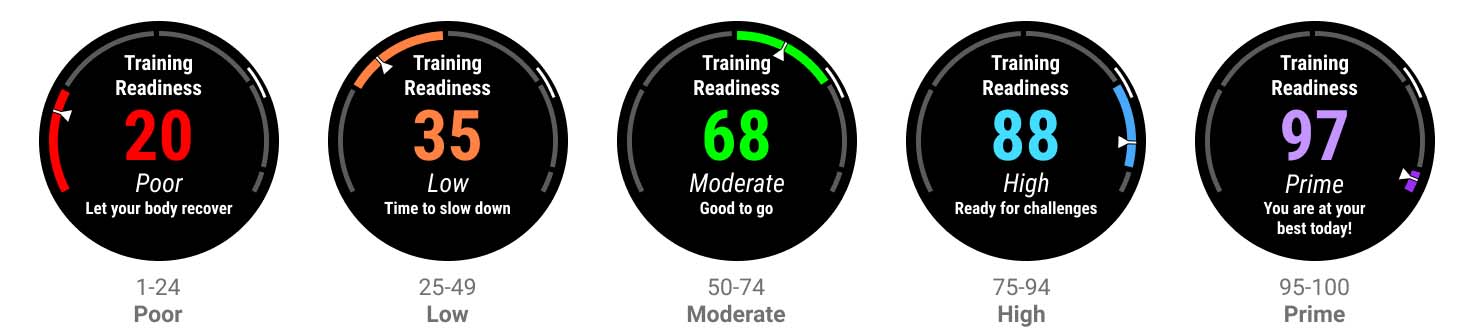
The Training Readiness feature is an advanced insight designed to help you train as effectively as possible. You train hard because you want results, but pushing your limits before you're ready can have the opposite effect. See when you're most likely to benefit from a hard workout and when you should consider taking it easier to let your body recover.
This insight is built using a multi-level analysis that combines activity and lifestyle data. Your training readiness is rated on a scale with the levels poor, low, moderate, high and prime. In the widget, you can see your current readiness score and how the related factors have affected your current condition. You can also view this information as part of your morning report.
How Training Readiness is calculated
The main factors in assessing your training readiness are how well you slept last night and the recovery needed from recent activities. This information is based on your recovery time and advanced sleep tracking metrics. Your results are also affected by your training load trends, HRV (heart rate variability), recent stress levels and how well you slept before last night.
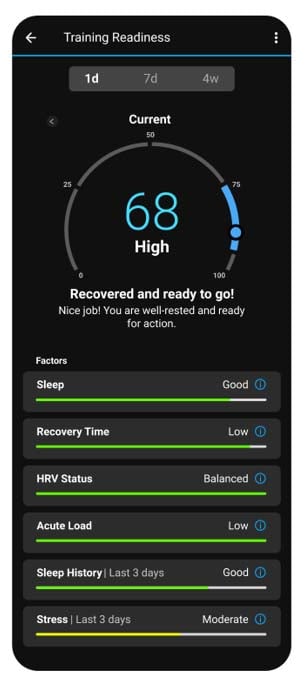
Sleep score. Your sleep score (0–100) shows how well you slept. It is based on your sleep duration, the distribution of sleep stages and signs of recovery in the autonomic nervous system reflected in your heart rate variability data. In assessing sleep quantity and quality, your sleep is compared to standards set by expert organisations.
Recovery time. This countdown timer shows when your body will have fully recovered from your last activity. The time on the timer depends on the intensity of your last activity and whether, and how much, recovery time was left on the timer when that activity began. The recovery timer can be sped up or slowed down by significant changes in sleep quality, stress levels and daily physical activity.
Acute training load. An optimal acute load indicates that the combined effect of your recent activities is sufficient to maintain and improve your current fitness. If you don't keep a constant eye on overload, it can compromise your functional performance and increase the risk of injury. When you record an activity, its total effect is added to your current acute load. The effect of that activity gradually decreases and disappears over the next 10 days.
HRV status. A balanced HRV means that your seven-day average HRV is within your personal baseline. This is a good sign, as it shows your body has been coping well with life's challenges. An unbalanced HRV status may indicate insufficient recovery, excessive workload, alcohol consumption or an immune system fighting illness.
Sleep history. Your sleep score shows how well you slept last night. But one good night doesn't completely erase the long-term effects of serious sleep deprivation. So your sleep history is influenced by how well you slept before last night.
An exceptionally long period of wakefulness (e.g. 20 hours) before your last night's sleep can also reduce training readiness.
Stress history. Tracking stress throughout the day reveals when your body is mobilising resources to help you cope with life challenges unrelated to training. Stress is a normal part of life, but higher stress levels over a longer period can reduce resilience and minimise the benefits of training. Your stress history includes your awake stress levels from the last three days.
How Training Readiness changes during the day
Checking your training readiness first thing in the morning helps you set reasonable expectations for the day.
The biggest change in your readiness level happens as soon as you wake up in the morning. That's when your sleep score from last night, HRV status and longer-term sleep history are updated, along with a complete overview of your acute training load and stress history.
Your training readiness is then updated throughout the day based on how your condition changes. You can expect your readiness score to increase once your recovery timer reaches zero. When you record an activity, you will later notice a drop in readiness reflecting your current need for recovery. Light efforts have minimal impact, but hard workouts can significantly reduce your readiness.
If my training readiness is low, can I still train?
Any good coach or experienced athlete can tell you that at certain times it's best to look beyond daily goals. Training camps and high-volume block training are valid methods and can be very effective when used correctly. Typical block training often includes deliberate overload over several consecutive days, balanced by an extended recovery period.
If you train using a block training model, this will likely show up as a lower training readiness score during the deliberate overload period. However, you should check which factors are causing the lower score. Higher-than-usual acute training loads and longer recovery time estimates are expected during block training. Reduced readiness caused by other factors (e.g. sleep history or high stress levels) may be a reason to reassess your training plan.
The insight from the Training Readiness widget is just one of the perspectives you should consider when planning your training. Always listen to your body, take into account how you feel when using the data, and adjust your plans and expectations accordingly.
Training readiness vs. performance readiness
Quite rightly, several questions arise. Are training readiness and performance readiness one and the same? Can your training readiness score on the morning of an important race day predict (or even determine) how well you'll do? Does a readiness score below prime mean it's time to abandon your pacing strategy and not get your hopes up too high?
Sometimes you may notice a link between training readiness and performance, but training readiness analysis isn't actually intended to predict performance. Many athletes have reported sleeping poorly the night before an important event yet still achieving impressive results and setting personal records. Stress levels can also rise due to anticipation and excitement about a big day.
Training readiness focuses on the relationships between strain, stress, recovery, good sleep hygiene and your body's ability to maintain homeostatic balance. The guidance is designed to help you build a foundation for success, get the most out of your training and improve your performance over time.
Race-day performance is a matter of realising and applying those abilities.