
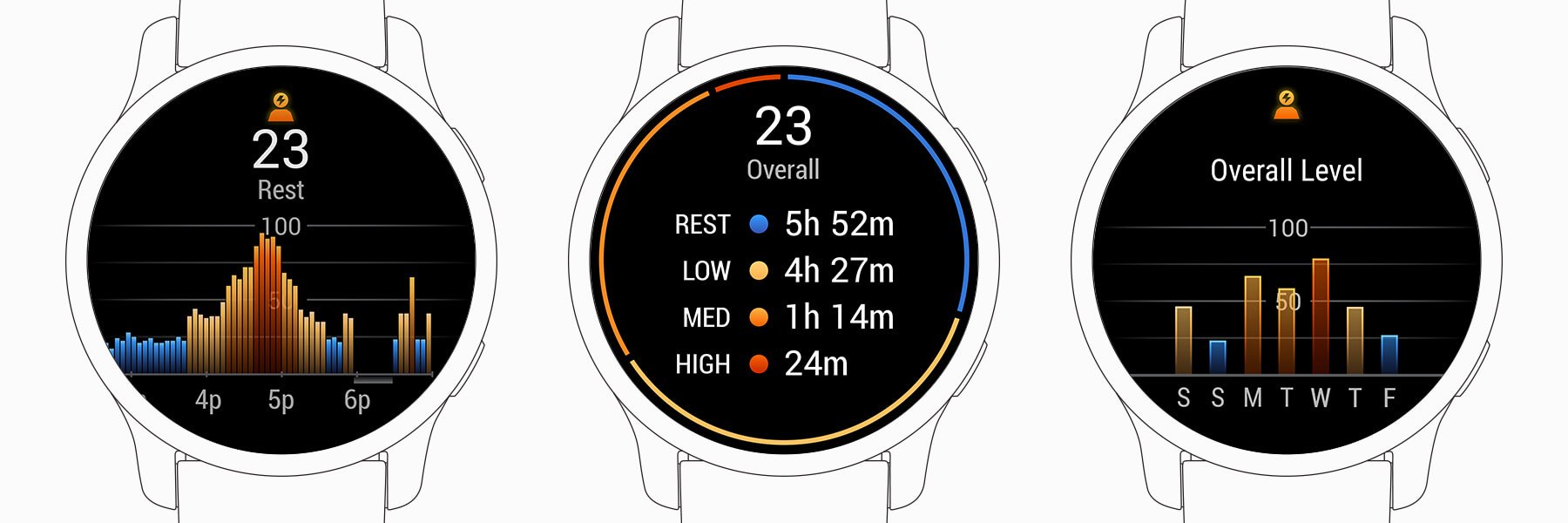
Stress Tracking
Stress is our body's natural response to the challenges that life and our environment present. It is a heightened physiological state that prepares you to respond quickly to what lies ahead. All-day stress tracking with a Garmin smartwatch is based on a recognised and scientifically validated understanding of your autonomic nervous system (ANS)1.
Stress levels (0–100) are estimated by the Firstbeat analytics engine, mainly from heart rate and heart rate variability data. This data is recorded by the optical heart rate sensor on the back of your device.
Your autonomic nervous system, which is divided into the sympathetic and parasympathetic branches, regulates your physiological systems so they best match your current situation. The sympathetic branch is dominant when it is time to act. Your heart rate rises, blood vessels dilate, digestion stops and adrenaline starts to flow. This is also known as the fight-or-flight response. In calmer times, the parasympathetic branch is more dominant and your body enters the so-called rest-and-digest mode. In this mode, your body can repair itself and restore the resources used during more restless moments.
Sleep is a particularly important time for your body to recover, and naturally the parasympathetic branch of your autonomic nervous system is most active while you sleep.
Your Garmin device does not measure stress levels during physical activity, because the load of physical activity could be interpreted as stress. The effect of physical activity is best measured and understood in other ways. Public speaking or running up the stairs can both make your heart pound, but the underlying causes are fundamentally different.
Wear your device regularly for more personalised feedback
Your physiological parameters and your body's response to stress are unique. Accordingly, the analytics used to track your stress level are designed to recognise your personal situation and adapt to it. For best results, wear your device as much as possible, especially while sleeping, as that is when your stress levels are usually lowest. This helps to better understand all the states of stress and relaxation you experience.
Wearing the device intermittently also helps to understand your stress, but the details and exact levels may be less personalised compared to more consistent use.
Understanding all-day stress tracking
Your stress data shows your physiological states throughout the day based on the activity of your autonomic nervous system, which regulates your body's responses in the background.
Selected Garmin devices can be set to alert you when your stress level is unusually high. The alert prompts you to take a moment to rest, and the device invites you to start a guided breathing exercise using the relax reminder breathing timer.
The stress chart on your device or in the Garmin Connect™ app shows orange bars when your stress level is above 25. When the level is below 25, the stress chart is blue. This contrast is important for identifying states of stress and relaxation.
At a level of around 25, the sympathetic (stress: fight-or-flight response) and parasympathetic (recovery: rest-and-digest mode) branches of your autonomic nervous system are more or less in balance. At higher levels (25–100), sympathetic activity is stronger to prepare you for action. Lower levels (0–25) indicate that your parasympathetic system is more active.
However, your stress data does not tell you why these different states occur. That is why it is important to notice the stressors in your life and your body's response to them yourself. This way you get the most out of the stress data collected by your Garmin device and can start looking for more effective strategies for coping with stress.
Elevated stress levels can come from, for example, high pressure at work, social anxiety or simply encountering an aggressive driver on the road. Elevated stress levels can also result from happier situations, such as excitement about a new job, anticipation of a first date or the jitters a runner feels on the morning of a big race. Keep in mind that overtraining, consuming stimulants, poor nutrition and getting sick can also cause higher than usual stress levels.
Whatever the causes of your stress, the key to a healthy, balanced lifestyle is balancing these draining experiences with relaxing moments and quality sleep.