
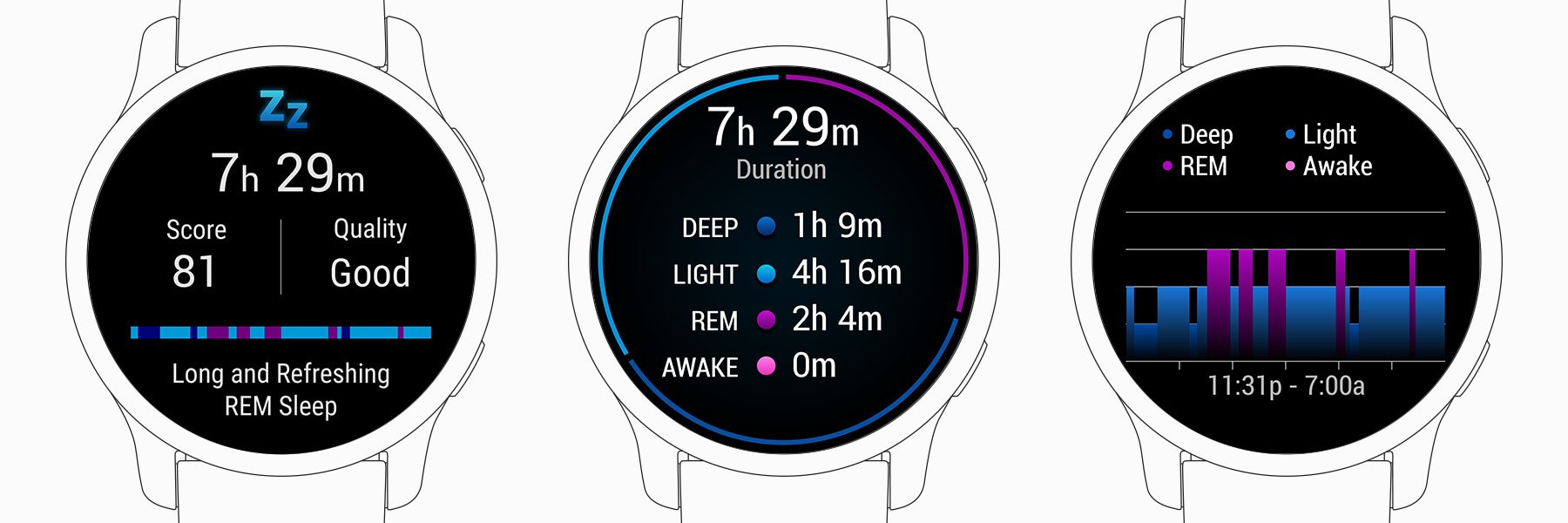
Advanced sleep tracking on compatible Garmin devices takes several factors into account to help you understand your sleep1. In addition to basic data such as when you fell asleep and woke up, you can also see when you were awake and how much time you spent in the main sleep stages (light, deep, REM). You can also see when these stages occurred during the night.
A combination of heart rate, heart rate variability and body movement data is used to identify sleep time and sleep stages. The age entered during setup and your established personal physiological baselines provide valuable context for the analysis and improve sleep tracking accuracy.
Compatible Garmin devices also track your respiration rate and blood oxygen saturation (Pulse Ox) levels during the night. Adding this information to your sleep profile gives you a more comprehensive overview of your sleep.
Understanding your sleep
Sleep is essential for physical and mental well-being. Regular, quality sleep promotes good health, can improve your mood, helps maximise the benefits of training and has many other advantages.
View your sleep data and track changes and trends over time. This helps you understand the often very complex relationship between what you do while awake and how well you sleep at night.
A bad night's sleep may be easy to explain away in the moment, but spotting long-term trends can be a powerful motivator for making lasting changes. And when things are going well, the evidence gives you the confidence of knowing you're on the right track.
Sleep score
Select Garmin devices with advanced sleep tracking also provide a sleep score. Nightly scores (0–100) can be combined with personal insights from your own activity and lifestyle data. These tips appear when there is an opportunity to help you understand how factors such as daily stress levels, activity patterns and bedtimes affect your sleep.
How the sleep score is calculated
Your nightly sleep score is calculated using a combination of sleep duration and sleep quality factors. Your sleep duration is compared with globally recognised age-based recommendations2. The quality aspects of your sleep score are derived from a combination of sleep architecture, stress data, sleep interruptions and other factors3.
Sleep architecture refers to how much time you spend in light, deep and REM sleep and the patterns formed by transitions between these stages during the night. The stress element is an analysis of heart rate variability, used to interpret the balance between sympathetic and parasympathetic activity of your autonomic nervous system. When your heart rate is low and your heart rate variability is high compared to normal, this is a strong indicator of parasympathetic dominance, meaning your body is in a state of rest and actively restoring resources used during the day.
Other factors that affect your sleep score include restlessness, the number of times you were awake for longer than 5 minutes and your total time awake.
Sleep stages
In a sleep lab, sleep stages are identified by specific brainwave and neuronal activity patterns. These patterns are often expressed physiologically as changes in heart rate, heart rate variability and breathing patterns. Detecting these physiological changes during sleep provides valuable clues for identifying sleep stages in real-world conditions outside the sleep lab.
Research has shown that each sleep stage plays its own part in your mental and physical recovery.
Light sleep (N1, N2)
Light sleep is the first stage of sleep. During light sleep, eye movement and muscle activity slow down and the body prepares for deep sleep.
Deep sleep (N3)
When you enter deep sleep, eye and muscle movement stops completely. Heart rate and breathing slow down. In this stage it is hard to wake you, and if you do wake up, you feel disoriented. Deep sleep is generally recognised as beneficial to health in many ways. For example, it helps muscles recover.
Rapid eye movement sleep (REM sleep)
REM sleep is considered the final stage of the sleep cycle. Dreaming often occurs during REM sleep. REM stages are short at first but get longer during the night. It is believed that during REM sleep the brain processes and organises information. It may even be linked to how we learn new skills.
Awake
In general, it is best when sleep is continuous through the night with few or no periods of being awake.
Movement-based sleep tracking
Older Garmin devices and devices without a built-in heart rate monitor use movement-based sleep tracking to analyse wrist or body movements detected by the accelerometer. This algorithm also takes the time of day into account and provides a simpler overview of your sleep. It can estimate whether you are awake or in light or deeper sleep. However, identifying specific sleep stages is not possible with these devices.

1See Garmin.com/ataccuracy
2“National Sleep Foundation’s updated sleep duration recommendations: final report”, Sleep Health, Epub 2015 Oct 31, pp. 233–243, 2015.
3“National Sleep Foundation’s sleep quality recommendations: first report”, National Sleep Foundation, Sleep Health, Vol. 3, No. 1, pp. 6–19.