

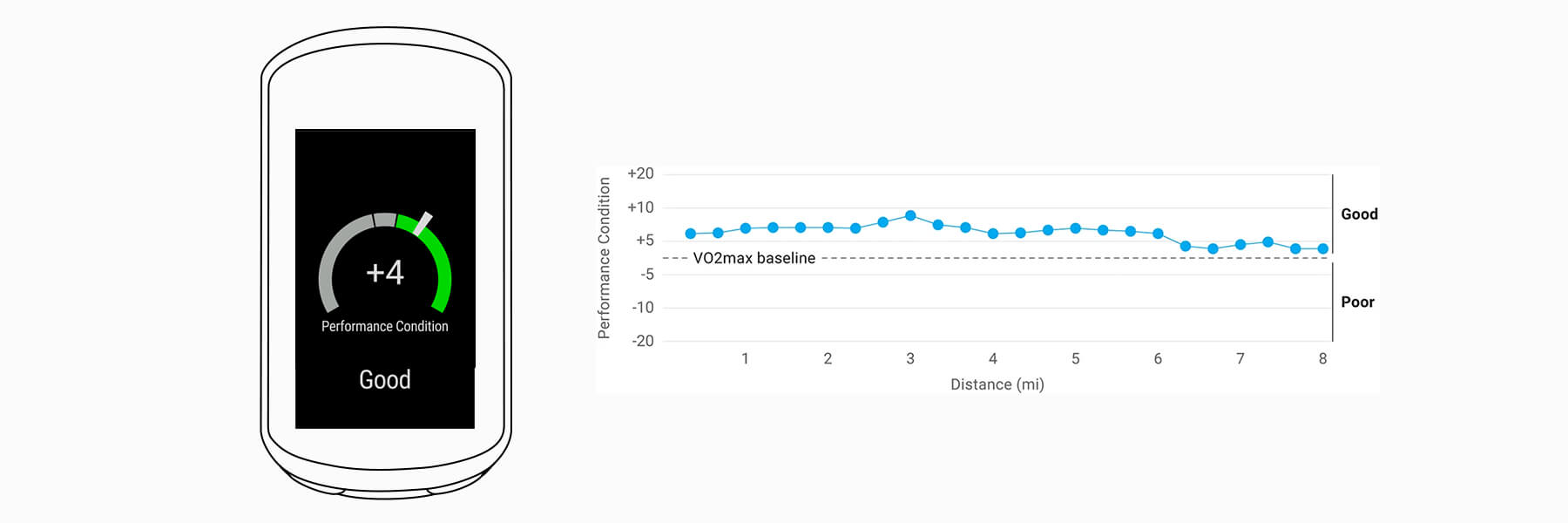
For a real-time assessment of your current ability to perform, look at your performance condition. During the first 6 to 20 minutes of your ride, this metric analyzes power, heart rate and heart rate variability (HRV). The resulting number is a real-time assessment of the deviation from your baseline VO2 max, with each point on the scale representing about 1% of your VO2 max. The higher the number, the better you can expect to perform. Keep in mind that your results may vary a bit during your first few rides with a new device, since it’s still learning your fitness level. This will stabilize, and checking your performance condition will become a reliable day-to-day indicator of your capability.
In addition to the alert during the first part of your ride, you can add performance condition as a data field to your training screens — and keep an eye on it as your ride unfolds. The value may move around slightly as you encounter hills or strong winds, but it will trend down once you have been going hard for a while and the ride starts to take a toll on you. This is an objective way to keep an eye on how your ability to perform is or isn’t declining as you go, because it’s telling you if your body is working harder than normal to ride at your current power output. So, performance condition can give you a bit of an early warning before you “bonk.”