

Understanding Garmin Cycling Ability and Event Profiles
The new Garmin Edge 1040 introduces cycling ability and event course profiles powered by Firstbeat Analytics. These unique tools are designed to reveal your strengths as a rider and where to focus your efforts to improve. You can even analyze courses to understand their demands. Compare your current ability profile to the performance demands of a route to see when you are ready to race.
What kind of cyclist are you? Spend time in the saddle and you are sure to wonder what you are truly capable of on your bike. How do I compare to other riders? What kind of challenges best highlight my abilities? How have my abilities changed from last year and what is holding me back now?
Your Garmin cycling ability profile, rider type and course profiling tools answer these questions and more.
Building Your Cycling Ability Profile
Compatible Garmin devices construct your cycling ability profile using advanced analytics. Sophisticated algorithms apply physiological models to interpret combinations of heart rate and power data during your rides. You can ensure the quality of your profile by recording all your training activities with a both a heart rate monitor and a power meter paired to your device. Fresh activity data keeps your profile active and you can expect your profile to expire after a month of inactivity.
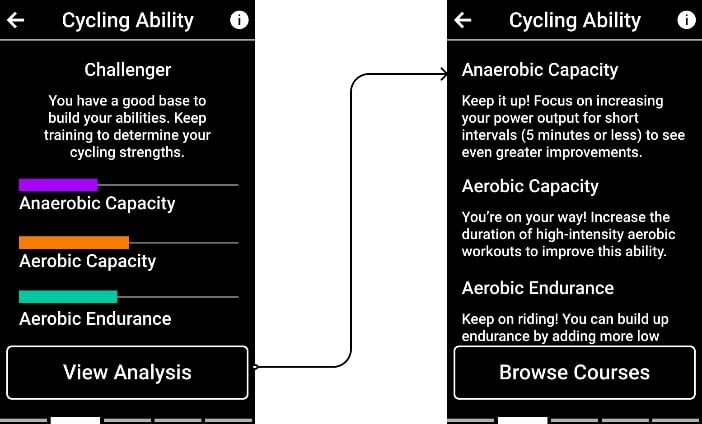
Challenger Profile Example
Endurance Specialist Profile Example
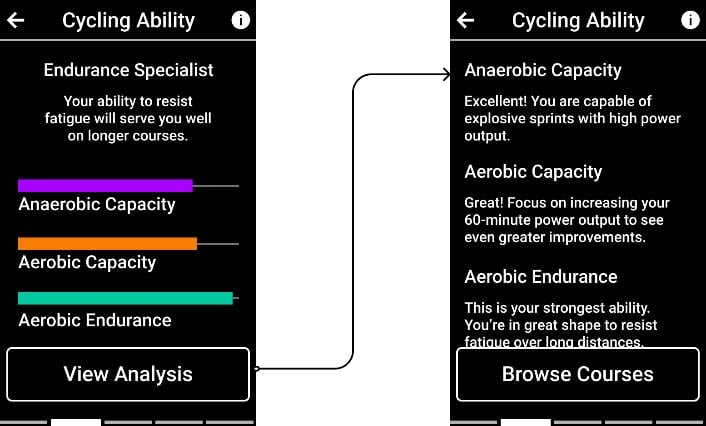
The goal of analyzing this data is to reveal your ability to perform across the three key performance categories: aerobic endurance, aerobic capacity, and anaerobic capacity. Full marks in a category reflect world-class ability.
This goal is achieved by considering combinations of VO2 max, power curve data, recent and longer-term training load distributions along with the intensity and duration of relevant rides. Combining these different perspectives creates a more robust portrait of your abilities than otherwise possible.
| VO2 max | Power Records | Training Load Focus | |
|---|---|---|---|
| Anaerobic Capacity | 5sec, 1min, 5min | Anaerobic | |
| Aerobic Capacity | ✔ | 20min, 60min | Aerobic High |
| Aerobic Endurance* | ✔ | 120min | Aerobic Low |
*Aerobic Endurance also incorporates an analysis of duration and intensity data from relevant rides in your activity history.
Your cycling ability profile can be interpreted to reveal where your advantages lie and where you have room to improve. Strengths and weaknesses reflected in your cycling ability profile stem from a mixture of genetic predisposition and the work you invest during training sessions.
Determining your Rider Type
Your current rider type is identified once your device has enough data to confidently assess your abilities. In addition to your performance abilities, information you enter about yourself, like body weight for example, also helps determine your rider type when it impacts what you can achieve.
Some riders have natural advantages when it comes to sprinting, endurance or climbing for example. Against that background, you can improve your abilities and even shift your ability profile and resulting rider type by modifying your training program.
Rider types include Challenger, All-rounder, Endurance Specialist, Road Sprinter, Flat Specialist, Climber, Puncheur, and Sprinter.
The first step towards classifying your current profile is to confirm basic fitness in at least one of the three performance categories. When general training is your best opportunity for development, your rider type is identified as Challenger. This gives you an opportunity to focus on building your base before specializing.
Once basic fitness levels are confirmed, the classification process starts from your strongest ability and proceeds based on your relative strengths in the other two categories. For example, if aerobic endurance is by far your strongest ability, then your rider type will logically be classified as Endurance Specialist. If your aerobic endurance and anaerobic capacity are equal with aerobic capacity lagging, then your rider type will be identified as a Road Sprinter. When your aerobic endurance, aerobic and anaerobic capacities are equal, the All-rounder designation comes into play. This jack-of-all-trades category is common but is often temporary, fading with time as your training efforts progress.
Always consider the quantity and quality of recent training activities when looking to your rider type for guidance. Are you currently at or near the peak of your powers? Working your way back into shape? Your most natural personal profile emerges with well-balanced training sustained over time.
| Classification | Description |
|---|---|
| Challenger | Regular training with a balanced approach holds the key to across-the-board development of your abilities over time. |
| All-Rounder | Each of your performance capacities falls in a similar range and you are likely competitive in a range of events. |
| Endurance Specialist | Fatigue resistance gives you an advantage over the course of long rides performed steadily and with moderate intensity. |
| Road Sprinter | Combined strengths in endurance and anaerobic capacity translate into an ability to punctuate long rides with powerful attacks. |
| Flat Specialist | Pushing your limits on flat courses benefits from the strong capacity of your aerobic energy pathways. |
| Climber | Strong aerobic capacity combined with advantages in power-to-weight ratio return benefits on long and steady climbs. |
| Puncheur | Rolling hills and repeated sprints are ideal turning this combination of aerobic and anaerobic capacities into an advantage. |
| Sprinter | Strong anaerobic capacity translates into a preference for short bursts of pure power and speed. |
Course Profiles and Ability-based Selection
Ready to hit the road? Courses you create or discover in Garmin Connect can be analyzed to reveal what kind of challenge they present. Once a route is analyzed, the demands of that route can be compared to your cycling ability profile to reveal if you are up for the challenge.
Fully understanding the demands of an upcoming race means being able to adjust your preparation and track progress towards your targeted event. On race day, you can approach the starting line confident you are well-prepared for the road ahead.
Analyzing the demands of a course starts by considering total distance. A strong aerobic endurance base sets the stage for success in racing long distances. Other considerations factored into the assessment include total elevation gain together with the frequency, distribution, and grade of hills along the way. A flat 20- to 30-mile race can be the perfect opportunity to show off your aerobic capacity. Even shorter courses and rolling hills may rely more on a combination of your aerobic and anaerobic capabilities.
Keep in mind that there is a difference between being able to ride a route and racing it. The performance ability demand profile for each course is generated with hard racing in mind. When you see that the demand profile of a given course is beyond your current abilities, it does not automatically mean you are unable to ride and complete the course. It simply means you will find yourself taking a more relaxed approach at times along the way.