
Garmin Edge 1040 (Solar) review

14.06.2022
 Reading time: 5 minutes
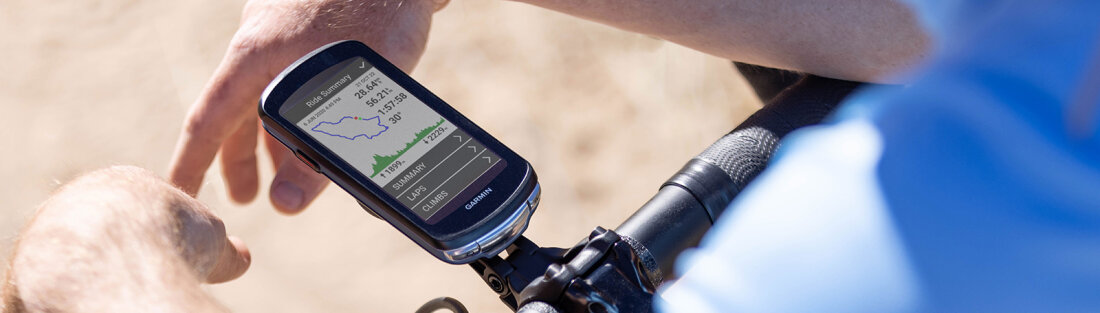
Garmin has unveiled the Edge 1040 series, the first bike computer with not only solar panels but also multi-band GNSS support – greatly improving GPS accuracy, especially in tougher conditions.
On top of that, Garmin has added long-requested upgrades, including USB-C support, a metal mount, and much faster route calculation and destination search.
Beyond that, there's a host of new features, as we always see when Garmin launches a new device. These include the new Power Guide feature, which creates race- and training-day plans and targets for a specific course, along with features that help identify your cycling ability and how it matches the difficulty of a given course.
WHAT'S NEW:
The Edge 1040 is largely an evolutionary rather than revolutionary update. That said, with its complete user interface redesign, it effectively represents a break from the past. A dividing line, if you like – and as such we see new features that take advantage of this interface, but also a handful of features that have been removed.
- Added Solar model
- Added Power Glass on the solar model
- Solar model storage increased from 32GB to 64GB
- Preloaded North America, EMEA, AU/NZ maps added on the Solar model (base model has European maps)
- Added multi-band/dual-frequency GNSS/GPS
- Added USB-C connection
- Rear mount replaced with a metal mount
- Completely redesigned user interface
- Lanyard attachment changed so it no longer goes through the charging port cover
- Connect IQ widget previews added to the home screen/dashboard
- Added Power Guide for training and race guidance on any course
- Added Cycling Ability to identify a cyclist's strengths and weaknesses
- Added Course Demands to compare a course against riding requirements
- Added Real-Time Stamina to show remaining energy/distance/endurance during a workout
- Added location search app
- Added Recent Finds to the navigation panel (to find recent searches)
- New "Bike Shops" and "Water Stop" categories added to navigation search (other categories completely reworked to get rid of car-centric ones)
- Added post-ride Climb Pro on the device
- Added primary training schedule editing
- Added support for daily suggested workouts based on a race or event
- Connected sensor info added to the summary page (including 3rd-party sensors)
- Added Shimano STEPS support (eBike component)
- Added a new consolidated post-ride personal records screen
- Estimated battery level added when enabling battery saver mode
- Added manual WiFi sync button (a 'do it now' option, but the single-ride upload option has been removed)
- Added phone-based data field configuration
- Added on-device Garmin Connect IQ App Store support
- Nearby POI/Things search made insanely fast. Holy cow.
- Much faster route calculation times
- Expanded ClimbPro colour scale to show more definition
- Now automatically changes map popularity type to match the activity (e.g. road vs mountain bike)
- Removed the horribly unreliable dual Bluetooth pairing process for phones
- Varia Vision sensor support removed
- Device-to-device data sharing removed
- Same screen resolution as before
- Same touchscreen as before
- Weight increased slightly from 126 grams to 133 grams
- Battery life almost doubled from 24 hours to 45 hours (in multi-band GPS mode with solar)
As usual, people often ask whether any of these features will be added to existing Edge devices, and unfortunately this time the answer is no. Although Garmin has added a huge number of features to the Edge 1030 since its release (including practically all Edge 1030 Plus features), and many features have also been added to the Edge 530/830/1030 Plus since their launch, this time no new features will be added to older models.

Solar
This section focuses entirely on the Edge 1040 Solar version, which includes solar charging technology. This solar panel (obviously) supplies the device with solar energy, extending battery life both while riding and (in theory) while just chilling on a table in the sun.
Starting with the solar panel itself, it's essentially split into two. The first is the most obvious part of the panel at the top and bottom of the screen. This is the visible part, and its photovoltaic level is 100%. In the most simplified terms, 100% of the solar energy hitting this part of the panel is converted into energy (there are many technical nuances, but again, this is a simplification).
But there's another solar panel across the entire screen with a photovoltaic level of 15% (a notable increase over the Fenix 7 and Forerunner 955 panels, which are 7%). This main panel is obviously much larger than the top and bottom panels, but collects less energy since it's only 15% vs 100%. However, you can see through it, so it's essentially invisible. Garmin calls it "Power Glass" because it actually is glass.
When riding in the sun, you get a new solar data page showing the exact solar energy collected (in minutes:seconds), the ride's average solar intensity and a small graph showing solar energy throughout the ride.
The solar battery figures are based on 75000 lux conditions (a measure of brightness), another increase over the previous 50000 lux conditions for Fenix/Instinct/Forerunner devices. This is actually a more useful change, because 50000 lux conditions aren't really that high. Even on a sunny winter day it can reach 70000 lux. Meanwhile, in summer in a warmer place you can hit 125-150000 lux. Garmin collects all available extra lux, so it isn't capped at 75000 lux.
Honestly, these results can be impressive. We placed the device in the sun for about two hours, at 70000 lux with occasionally cloudy weather, and gained 49 minutes of battery life. Depending on your windows and the sun, you can literally just leave the Edge 1040 Solar on a windowsill and let it recharge itself on most days.
Conclusion
It's fairly easy to say that the Edge 1040 Solar is the most advanced and accurate bike GPS we've seen so far. And I'm pretty sure it's also the longest-lasting bike GPS – battery-friendly and able to exceed its published battery specs. As I've seen and shown with the statistics above, it nearly doubles its published official specs in the most demanding power-consumption scenarios, regardless of sun conditions. And looking at the new multi-band GPS and accuracy, it continues to lead the way, even slightly ahead of the latest Forerunner 955. Ultimately, whether you're upgrading an older Edge device or looking for the undisputed best bike computer on the market, the Edge 1040 Solar won't disappoint you.